
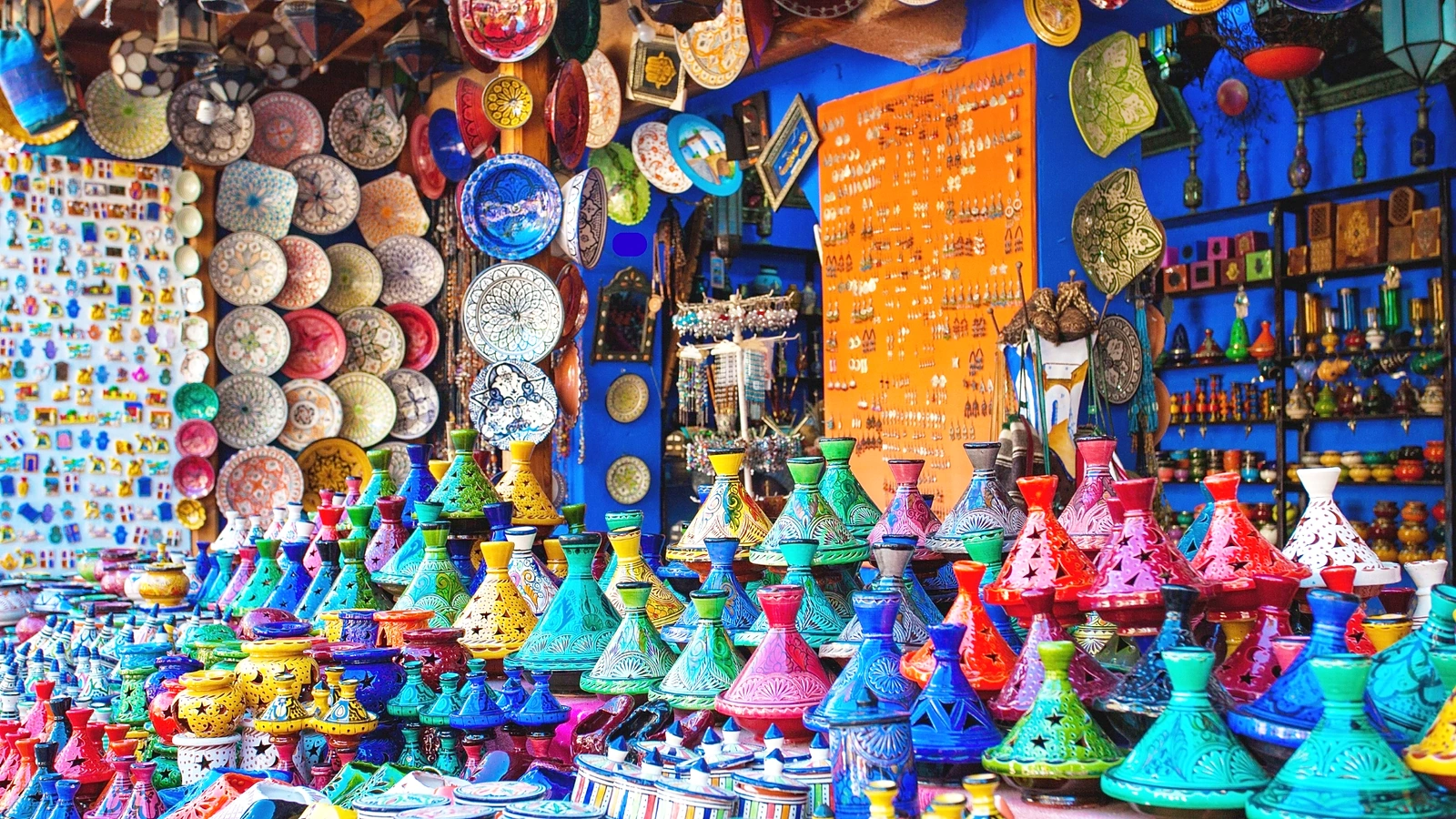
A souk is more than a market: it is a whole district where every alley has its own trade, where you watch leather being tanned, copper hammered and wool woven. In Morocco, shopping is an experience in itself, to be enjoyed slowly, a glass of tea in hand.
And for those who prefer fixed prices, a new generation of designers and design shops offers a more upmarket kind of shopping. Here is our guide to enjoying both.
Marrakech, a maze of craft guilds
North of Jemaa el-Fna square, the souks of Marrakech spread over hundreds of alleys. Most visitors enter through Rue Semmarine, and from there each guild keeps its own territory: babouches in Souk Smata, metal and lanterns in Souk Haddadine, wood in Souk Chouari, rugs around Rahba Kedima square, and skeins of coloured wool in the Dyers’ Souk.
Morning is the best time to wander: the craftsmen are at work and the alleys are still quiet. Many stalls close earlier on Friday, the day of the main weekly prayer.
Fes, where the crafts are made
In the medina of Fes, a UNESCO World Heritage Site, crafts are still made before your eyes. From the terraces overlooking the Chouara tannery, you can watch the vats where leather is dyed as it has been for centuries. On Seffarine square, coppersmiths hammer trays and cauldrons; further on, potters and zellige masters keep the famous Fes blue alive.
Elsewhere, every town has its speciality: thuya marquetry in Essaouira, pottery in Safi, rugs from the Middle and High Atlas, silver and Berber jewellery in Tiznit.
What to bring back from Morocco
- Rugs: Beni Ouarain in undyed wool, brightly coloured Azilal, boucherouite woven from fabric scraps. Take your time choosing a good rug: touch it and turn it over.
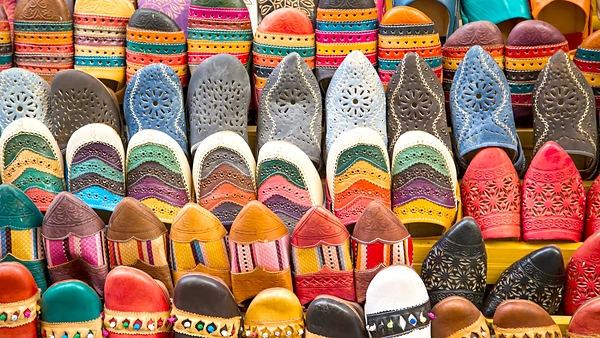
- Leather: babouches, bags, poufs and belts; look for even stitching and only a faint smell.
- Ceramics and zellige: decorative tagine dishes, bowls from Safi, tiles and mosaic tables.
- Lighting: chased copper lanterns and pierced metal wall lights, which can often be taken apart for the journey.
- Wood: boxes and trays in Essaouira thuya, with its unmistakable scent.
- Beauty and flavours: cooperative argan oil, black soap, rose water, spices and tea.
Chic shopping, designer style
In Marrakech, the Gueliz district and the Sidi Ghanem area, home to designers and interior workshops, bring together concept stores, fashion designers and galleries. Young designers reinvent the kaftan, the djellaba and traditional basketry, with prices on display. In Casablanca, the Maarif district and the large malls along the corniche host the international brands.
For fixed-price handicrafts, the ensembles artisanaux (government craft centres) found in most large cities are a good benchmark: they give you an idea of prices before you head into the souks.
The art of haggling
In the souks, prices are negotiable: it’s the custom, and it’s also a moment of exchange. A few rules make it enjoyable for everyone.
- Check prices before you buy, at a craft centre or with your guide.
- Only start bargaining if you are really interested in the item, and make a genuine offer.
- Stay smiling and patient: accepting a glass of tea doesn’t commit you to anything.
- Once both sides have agreed a price, the deal is done: there’s no going back.
- Beware of unofficial guides offering to show you a shop: they take a commission on what you buy.
The souks with a group
For a group, a visit to the souks needs preparing. We entrust it to official guides who know the craftsmen and steer clear of commission shops, and we shape it around your wishes: a visit to a coppersmith’s workshop, a weaving demonstration, a treasure hunt in the medina for a team on a seminar, or a tour of the designers of Gueliz.
Your questions
What are the opening hours of the Marrakech souks?
Most shops open mid-morning and close in the early evening, every day. Some close earlier on Friday, the day of the main weekly prayer.
What should I bring back from Morocco?
A rug, babouches, a copper lantern, a piece of ceramics, cooperative argan oil, spices or tea: authentic souvenirs, from the lightest to the most precious.
Should you haggle in the souks?
Yes, it’s the custom in the souks, but not in fixed-price shops, craft centres or malls. Stay courteous and only name a price if you are ready to buy.
Can you pay by card in the souks?
More and more shops accept cards, but small craftsmen prefer cash: always keep a few dirhams on you.
Planning a trip to Morocco?
Agencies, tour operators, companies: our teams in Casablanca and Marrakech put together your tailor-made stay or tour in Morocco.